
We did not roll out tablets across the shop floor.
We did not roll out tablets across the shop floor. We started with two operators and five days.
When we first introduced tablets, the idea looked straightforward. Move away from paper, capture data digitally, and bring everything into the system. But the moment we put the devices on the shop floor, reality showed up.
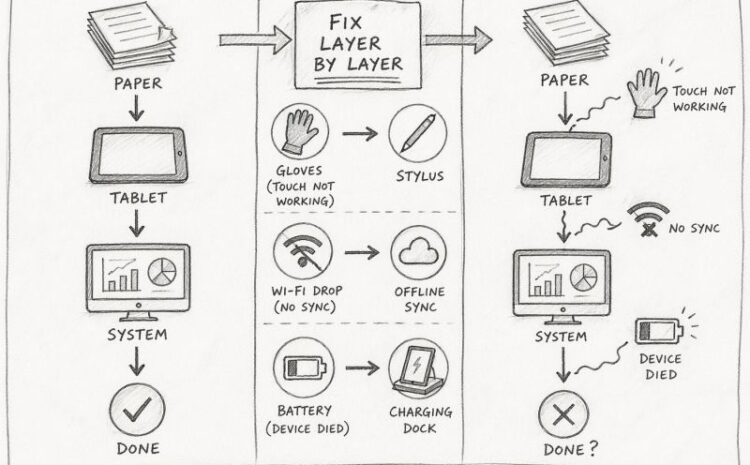
On the first day, the screens were not responding properly. Operators were wearing gloves, and the touch interface simply did not work the way we expected. We added a stylus.
On the second day, the Wi-Fi dropped in certain areas. Data was not syncing, and the system felt unreliable. We enabled offline sync so work could continue without interruption.
On the third day, batteries started dying midway through shifts. We added charging docks at the right points.
None of these issues were surprising in hindsight. What mattered was how we handled them.
Because we had limited the trial to just two operators, the problems stayed contained. We were able to observe, fix, and improve without creating disruption across the factory.
By the end of the week, the system was stable. Not because the idea was perfect, but because the testing was deliberate.
That experience shaped how we approach any new system.
We do not try to get everything right before starting.
We start small, expect things to break, and fix them quickly.
When you contain the experiment, failure becomes manageable.
And once the system works in a controlled setting, scaling becomes a much simpler decision.