
Most factories do not move slowly because they lack data.
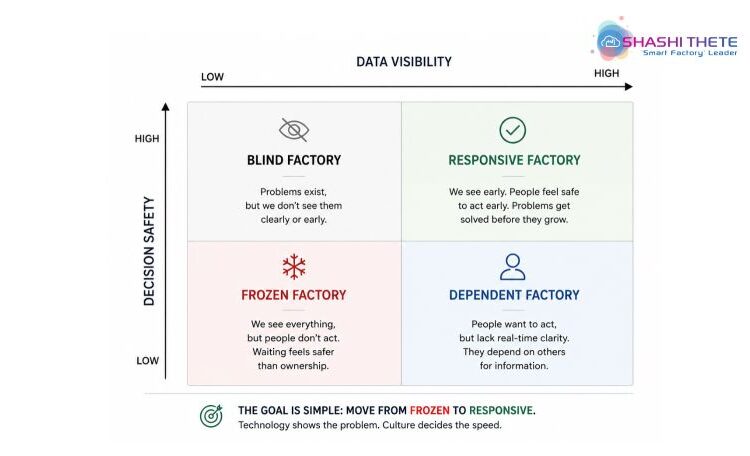
Most factories do not move slowly because they lack data. They move slowly because people are afraid of what happens when they act on it.
Over the years, I have seen many organisations invest heavily in dashboards, analytics, and live monitoring systems. Screens go up across departments, data starts flowing in real time, and leadership expects decisions to become faster.
But very often, nothing really changes.
The dashboards are live.
The delays are still live too.
What most people miss is that data does not automatically create speed. In many cases, it creates exposure. The moment information becomes visible, accountability becomes visible with it.
And that changes how people behave.
In traditional manufacturing environments, there is often an unspoken system operating underneath everything. I call it the “blame economy.”
People learn very quickly that acting fast and making a mistake attracts attention immediately. Waiting, however, feels safer. If the issue becomes big enough, responsibility gets distributed. More people get involved. The risk becomes collective instead of personal.
So even with live dashboards, people hesitate.
Not because they do not understand the problem.
Because they are calculating the consequence of acting on it.
This is why many digital transformation projects fail to create the speed they promise. The technology works. The psychology does not.
At Sigma, we realised early that if people are punished for making decisions, no software can make an organisation agile. You cannot build a responsive system on top of a fearful culture.
The real shift happens when people feel safe enough to act early, raise issues early, and solve problems before they become visible disasters.
Only then does real-time data become useful.
Otherwise, the dashboard simply becomes a faster way to watch people wait.