
A factory does not become smart because it installs software.
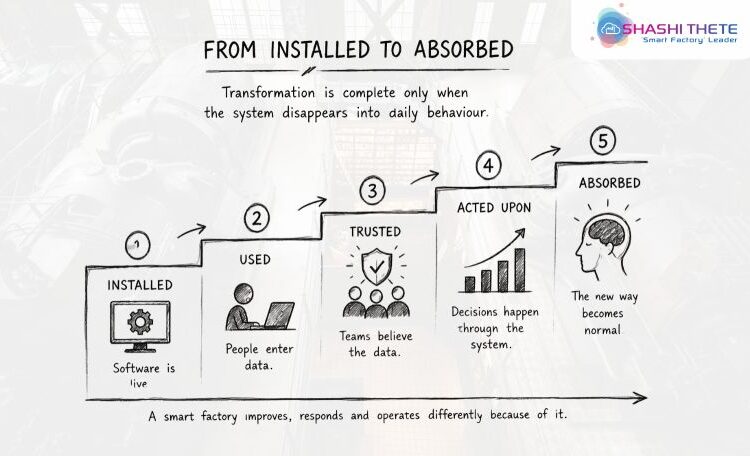
A factory does not become smart because it installs software. It becomes smart when the entire system starts thinking differently.
Over the years, we visited many factories that had expensive dashboards, modern machines, and advanced software, but the day-to-day operations still moved slowly. Delays existed, decisions were reactive, and teams continued depending on follow-ups and manual coordination.
That is when I started looking at transformation differently.
Instead of asking what software a factory needs, I began asking what capabilities a factory must build before any software can actually work properly.
That thinking eventually became our SMART Pentagon Framework.
The first pillar is Self-improving.
A factory should continuously expose its own inefficiencies instead of waiting for management reviews to discover them.
The second is Mindset of change.
Technology only works when people are willing to adapt, experiment, and improve the way they operate every day.
The third is Automation.
Not automation for appearance, but automation that genuinely removes dependency, delays, and repetitive coordination.
The fourth is Real-time.
Factories lose speed when information moves slowly. Real-time visibility changes how quickly teams can respond and act.
The fifth is Transparency.
Without transparency, every department starts operating with its own assumptions. Once information becomes visible to everyone, alignment becomes much easier.
What we learned at Sigma was that these five pillars cannot operate independently. If one weakens, the entire system slows down around it.
A project is not complete because the software is live.
It is complete when the factory starts improving, responding, and operating differently because of it.